

|
|
The "wet" numbers represent worst case for lines covered with ice or snow. |
Here's a quick line loss calculator to use Note that the simple program used for this web page gives a very close approximation for additional losses due to SWR.
|
|
||||||||||||||||||||||||
Online Coax Cable Loss / Antenna Gain Calculator
This program is provided "as-is". It is thought to be accurate but it is the responsibility of the user to verify the accuracy of the calculations when using this program.
INTRODUCTION-The long wire antenna is a very effective antenna for the listener who wants to cover all of the shortwave bands from 530 kHz to 30 MHZ. However, if you have some favorite frequencies that you listen to on a regular basis you may wish to consider a dipole antenna. This antenna is a fairly easy to construct antenna and will give you better reception on the frequency it is cut for. Think of a dipole as a long wire that has an insulator in the middle.
FREQUENCY-A dipole antenna will not only work well on the frequency it is cut for, but also for the multiples of that frequency. For example, if you cut a dipole for 7.0 Mhz will also work well on 14 Mhz, 21 Mhz, and 28 Mhz. This way if you can pick and choose your frequency you can make one antenna work on two or three bands.
LENGTH- To find out how long the antenna should be all you have to do is fill in a simple formula:
468 divided by FREQUENCY IN MHZ = LENGTH IN FEET
300 divided by FREQUENCY IN MHZ = LENGTH IN METERS (wavelength)
168 divided by FREQUENCY IN MHZ = DIPOLE LENGTH
(with end effect calculated in)
That is the only formula you need ever know to build a dipole antenna.
Calculator purposes: Each dipole leg length is a half-wave leg
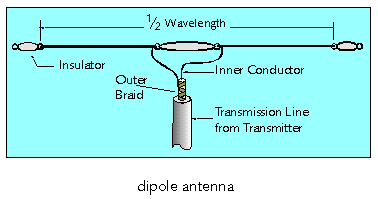
CONSTRUCTION- Once you have selected a frequency and calculated the length of wire you need to add two feet to this length. This is done so you will have six (6) inches of wire at each end to wrap around the insulators. Once you have this extended length of wire cut it in half. This will give you both sides of the dipole.
Attach an end insulator to one end of each piece of wire. You can use the egg-shaped insulators sold by many radio supply stores or make your own out of a piece of plastic. This can be done by cutting a piece of heavy plastic or plexiglass to a size of about six (6) inches in length and about 2-3 inches wide. Drill a small hole one to one and a half inches from each end of the plastic to wrap the wire around. It is best to solder these connections and wrap them in a sealant tape to keep the effects of the weather from harming them.
The other free ends are attached to a center connector which you can buy with a built-in coaxial cable connecter, or make your own. This will look similar to the end connectors but you will have to find a way to secure the coax lead wire to the insulator. If you build your own when you attach the coax to the ends of the wires, insure that you solder and wrap the connections. One wire will go to the center of the coax, while the other wire will go to the shielded braid of the coax. This will give you a perfect half-wave dipole. You should also wrap the coax fitting of the commercially available center insulator to keep water and other moisture out. Moisture will ruin the connections on any type of insulator and make the antenna less effective or at worst useless.
MULTI-BAND DIPOLES- As was stated above you can use the dipole on the harmonics or multiples of the frequency it is cut for. However, if you are short on space you can build a multi-band dipole. This way you will get an antenna that will operate on several frequencies. Instead of using a single strand of wire you can use wire that has several insulated wires in it. These MUST be insulated wires to ensure that they do not touch each other. You then cut the top wire to be the longest, the second wire to be the second-longest, the third wire to be the third-longest etc.. Only the longest wire is attached to the end insulators and all wires are fed to the center insulator to attach to the coax feed line.
INSTALLATION- Once you have the antenna cut all you have to do input it between two masts. Make sure that you use the free side of the end insulators to attach some rope. Tie this rope from the end insulators to the masts. Leave some slack on the antenna. If you pull too tight the antenna will break in the wind or if snow and or ice should coat the antenna. KEEP AWAY FROM OVERHEAD WIRES!! Keep away from these as should the antenna ever come into contact with an overhead wire you will do permanent damage to your radio if not yourself. All you have to do is feed the coax to your radio and listen to the stations come in. It would be best to install a lightning arrester in the coax feed line to help protect your receiver. These are available from many radio supply stores. Follow the instructions carefully! In areas where thunderstorms or snowstorms are common a lightning arrester is a must for safety.
You can install them flat or at an angle. If at an angle they will be more directional the direction that they are sloped. You can also install them as an inverted V shape. This dipole has a higher center with lower ends to save on space in smaller back yards. All three versions work well.